

Introduction
Why women avoid touch after 50 is a silent question that affects millions of women, yet very few speak about it openly. After menopause, the body and mind go through powerful transformations that can reshape the way intimacy feels. What once was a source of comfort and connection often turns into discomfort, obligation, or even something to avoid.
This isn’t just about physical desire. Avoiding intimacy after 50 can lead to guilt, emotional distance in relationships, and the painful belief that a part of femininity has been lost. But the truth is, intimacy doesn’t end after menopause—it simply changes its language.
In this article, we will explore the hidden reasons behind life after menopause intimacy struggles and, more importantly, share simple, natural steps to rediscover closeness, rebuild confidence, and reconnect with your partner—and with yourself.
The Hidden Reasons Why Women Avoid Touch After 50

Many women ask themselves: “Why do I avoid touch after 50 even though I still love my partner?” The truth is that intimacy after 50 is shaped not only by physical changes, but also by emotions, self-esteem, and the silent effects of menopause. This stage of life often brings transformations that outsiders cannot see—but women feel every single day.
Let’s look at the most common reasons why women avoid touch after 50, and how these factors create a cycle of emotional distance in relationships.
Hormonal changes after menopause
The natural drop in estrogen is one of the most frequent reasons behind the loss of desire after menopause. These hormonal shifts often cause:
- vaginal dryness,
- reduced elasticity of intimate tissues,
- lower natural lubrication.
For many women, these changes turn intimacy into discomfort instead of pleasure. What once felt natural and warm can begin to feel tense or even painful. This is why intimacy after 50 often needs a new approach: the body is asking for gentler care and different forms of connection.
Pain and physical discomfort
Pain is a silent enemy in relationships. Even soft, affectionate touch can feel uncomfortable when the body is sensitive after menopause. Over time, this creates a vicious cycle: the more intimacy is avoided, the more distant the memory of pleasure becomes.
Imagine entering an embrace already expecting discomfort. The mind quickly learns to associate closeness with pain, and avoidance becomes the natural reaction. This is one of the strongest reasons why women avoid touch after 50.
Emotional struggles and self-esteem
The changes of midlife are not only physical—they deeply affect how women see themselves. Skin, body shape, and energy shift, and many women describe feeling “invisible” or less feminine.
When self-esteem falls, touch no longer feels like an invitation but like an exposure. Instead of enjoying closeness, women may withdraw to protect themselves from the fear of judgment or rejection. This is how emotional distance after 50 quietly grows inside relationships.
The silent cycle
The more touch is avoided, the harder it becomes to accept it again. Couples often fall into a painful cycle: the partner feels confused and rejected, the woman feels guilty and pressured, and silence grows between them.
Without realizing it, both start living side by side yet apart. This is why many women begin to believe that intimacy after menopause has ended forever. But this is not true—the cycle can be broken, and pleasure can be rediscovered in new ways.
The Impact of Avoiding Touch After 50
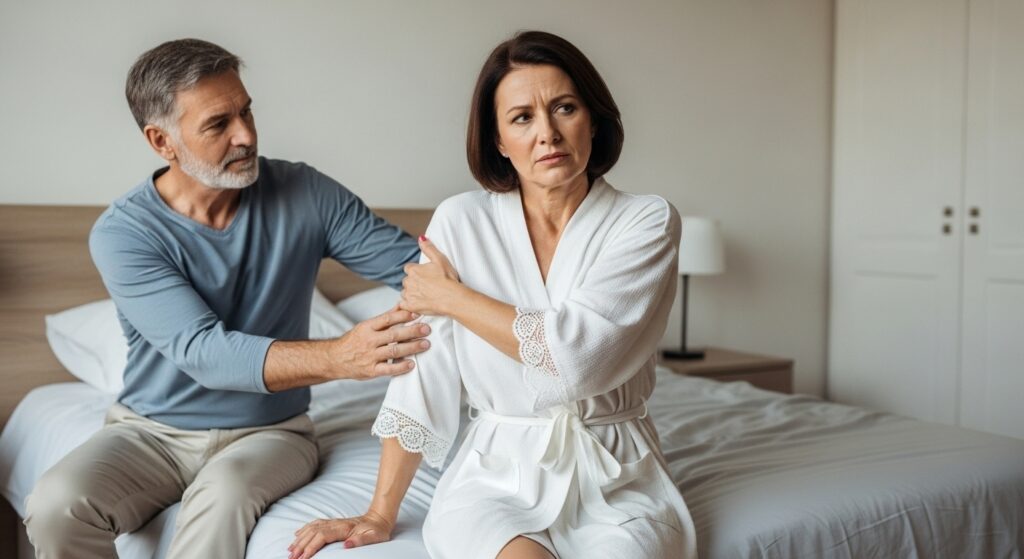
Avoiding touch after 50 is not only about physical intimacy—it affects the whole body, emotional health, and even the way a woman sees herself. What may look like a small change in the bedroom often turns into a ripple that touches every part of life.
Let’s explore how this distance impacts both women and their relationships.
The body feels the absence of closeness
Touch is one of the oldest forms of human connection. When we are touched with care, the body releases oxytocin—the “love hormone”—which reduces stress, improves mood, and strengthens emotional bonds.
When a woman begins to avoid intimacy after menopause, her body misses this natural source of balance. Over time, tension, anxiety, insomnia, and even fatigue may appear. The lack of physical closeness becomes a real health issue, not just an emotional one.
The emotional weight and sense of loss
For many women, the loss of desire after menopause feels like a piece of their identity has faded away. Common thoughts include:
- “I still love my partner, but I don’t feel the same anymore.”
- “It feels like my body has betrayed me.”
- “I pretend everything is fine so he won’t feel hurt.”
These unspoken feelings create guilt, frustration, and even deep sadness. The silence becomes heavier than the physical changes themselves.
Relationship struggles after 50
Intimacy is the invisible thread that strengthens a couple’s bond. When it weakens, relationships often begin to suffer. Partners may feel rejected, while women feel pressured or misunderstood. Miscommunication grows, arguments increase, and emotional walls are built.
Many long-term, loving relationships face crises not because love has disappeared, but because they don’t know how to handle intimacy after menopause.
The hidden effect on self-esteem
Avoiding touch also changes the way women see themselves. Every wrinkle, every change in the mirror can become a painful reminder that pleasure doesn’t feel the same as before. Self-confidence fades—not only in intimacy, but in daily life, social interactions, and even personal style.
This is one of the reasons why women avoid touch after 50: they stop believing they are desirable, even when they truly are.
The good news
Despite all of this, there is something essential to remember: intimacy does not disappear with age. It only transforms. With new practices, gentle self-care, and even natural solutions designed for women in midlife, it is possible to restore comfort, confidence, and pleasure.
The first step is breaking the silence and daring to believe that change is possible.
How to Change This With Simple Steps
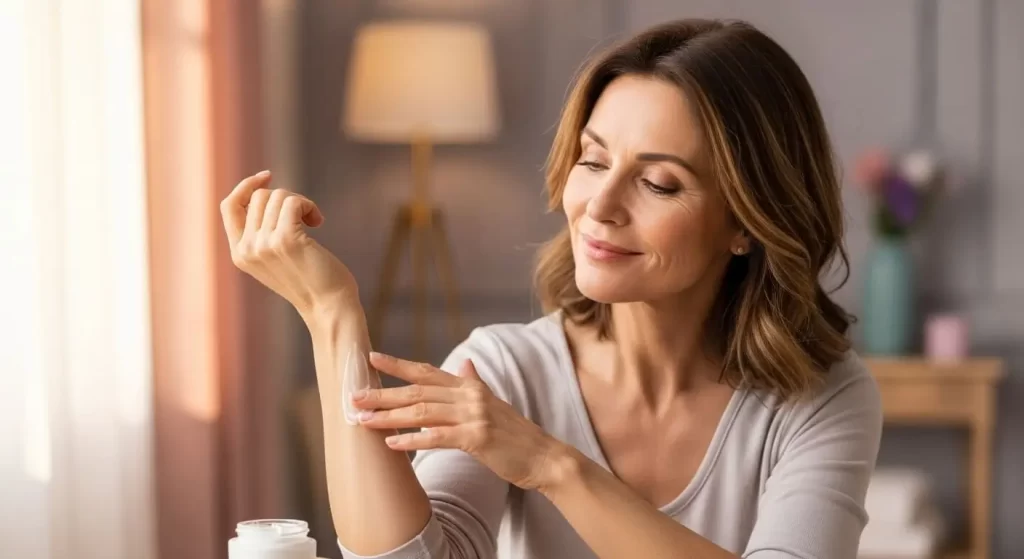
After understanding the reasons why women avoid touch after 50 and the impact this distance creates, it’s time to focus on what truly matters: change. The good news is that this transformation does not require miracles or drastic measures. It can begin with small, natural steps that gradually rebuild confidence, pleasure, and closeness.
Each of these steps is about reconnecting—with yourself, with your partner, and with the power of touch.
Rediscover your body through self-care
One of the most powerful ways to improve intimacy after menopause is to reconnect with your own body. Many women distance themselves even from self-touch, forgetting that pleasure can exist in small, everyday gestures.
Start with simple rituals:
- Take a warm shower and notice how the water feels on your skin.
- Apply body creams or oils slowly, paying attention to the sensations.
- Gently touch your hands, arms, and face—not with rush, but with presence.
These practices awaken the body’s sensory memory and remind you that you can still feel warmth, softness, and pleasure.
Talk openly with your partner
Silence is often more damaging than menopause itself. Many women avoid touch not only because of discomfort, but because they cannot explain what they’re going through.
Breaking this silence is the first step to reconnect after 50. Share how your body has changed, what feels uncomfortable, and what could help. Instead of creating distance, these conversations build trust and open the door to new kinds of intimacy—not just physical, but emotional as well.
Create new rituals of intimacy
Intimacy doesn’t begin in the bedroom—it starts in the small gestures of daily life. Rediscover closeness by creating new rituals with your partner:
- Hold hands during a walk.
- Exchange long hugs without pressure for more.
- Cook or dance together at home.
- Give and receive gentle massages.
These rituals reduce anxiety and rebuild the idea that touch can be comforting, not stressful. This is how couples rediscover intimacy after 50 in ways that feel natural and pressure-free.
Support your intimate health with natural solutions
For many women, the biggest barrier is physical: dryness, discomfort, or lack of natural lubrication. This is where natural solutions can become powerful allies.
One example is Vigorelle, a natural-based cream created to support women in midlife. It helps by:
- improving natural lubrication,
- increasing local circulation,
- enhancing sensitivity,
- restoring comfort during intimacy.
Women who include a female enhancement cream in their self-care routine often describe it as a “bridge” between insecurity and rediscovering pleasure. It doesn’t promise miracles, but it gently supports the body, making touch feel safe and enjoyable again.

Give your body time and celebrate small victories
Most importantly, there is no rush. Every body has its own rhythm, and every woman has her own journey. The key is not to pressure yourself, but to celebrate progress—no matter how small.
- A longer hug.
- A kiss that feels more meaningful.
- A night of closeness without fear.
These are victories worth recognizing. Each step forward is a reminder that intimacy after menopause can be just as fulfilling, in new and beautiful ways.
The First Step Is Simple
Changing your relationship with your body and intimacy may feel overwhelming at first. Many women believe they need to “go back to the way things were” in order to enjoy closeness again. This comparison only creates pressure and makes the distance feel even greater.
But the truth is that rediscovering intimacy after menopause doesn’t happen overnight. It begins with one small, simple step.
That first step could be:
- taking five minutes for self-care,
- opening up a gentle conversation with your partner,
- trying a natural solution that restores comfort,
- or simply allowing yourself to enjoy a warm embrace.
What matters most is breaking the silence and reminding yourself that you still deserve closeness, affection, and pleasure.
Think of it as planting a seed. Today it may feel small, but tomorrow it can grow into deeper connection, greater self-confidence, and a new sense of vitality. Each hug, each touch, each moment of openness is a celebration of your ability to reconnect after 50—not as the woman you were before, but as the woman you are now.
You don’t need to do everything at once. Just begin. Because once the first step is taken, the path to rediscovering intimacy becomes easier, lighter, and more natural than you might think.
Conclusion
If you have ever asked yourself why women avoid touch after 50, now you know the answer is not simple—and you are not alone. Hormonal changes, physical discomfort, self-esteem struggles, and emotional distance all play a role in shaping intimacy after menopause. But none of these challenges mean that intimacy is over.
Avoiding touch does not have to define your life or your relationship. It is simply a sign that your body is asking for a new kind of care. Pleasure doesn’t vanish with age—it transforms. And when you learn how to respond to your body in this new phase, you can rediscover intimacy in ways that are deeper, gentler, and more fulfilling.
The path forward begins with small, accessible steps:
- nurture yourself with self-care rituals,
- open honest conversations with your partner,
- create new rituals of closeness,
- and, when needed, lean on natural solutions that support your comfort and confidence.
Every gesture of kindness toward yourself is a step back toward connection. Each embrace, each moment of tenderness, is proof that intimacy after menopause can be just as meaningful—if not more—than before.
Remember: the first step is simple. Take it today, and you will see that it is never too late to reconnect after 50 with your body, your partner, and your femininity.
