
Introduction
“Pain during intimacy after 50 is more common than most women imagine. One of my patients once whispered to me with watery eyes: ‘Doctor, I wish I could relax… but my body closes up just thinking about it.’ This kind of pain is not just physical — it is silence, shame, and the feeling that intimacy has turned into fear.”
She said it quietly, almost as if confessing something shameful. But what I saw in her eyes wasn’t shame — it was fear. Fear of the pain that came without warning. Fear of a body that now retreats where it once welcomed touch.
Pain during intimacy isn’t just a symptom. It’s a silence. A quiet distance that settles not only between the thighs — but between words, glances, even the way a woman sees herself.
And unlike what many believe, it’s not simply about “dryness.” It’s about something deeper. A body that closes itself. Skin that pulls back. A woman who no longer knows if she can trust touch.
After 50, this discomfort becomes common — but it should never be considered normal. Science already understands the causes: hormonal shifts, changes in the vaginal tissue, decreased blood flow, imbalanced pH, and often, chronic pelvic tension.
But understanding the body is just the beginning.
This article is an invitation — to feel seen, to find clarity, and to explore ways of reconnecting with your body without pressure or shame.
If your body has started to fear what used to feel good — take a breath.
Because there are ways to ease that fear. Ways that don’t rush. Ways that gently open a new chapter in how you feel, move, and receive.
You are not broken. And it’s not too late.
The Discomfort That Has No Name

Sometimes the pain during intimacy after 50 is sharp. Other times, it’s just a lingering discomfort — enough to turn what should be a moment of closeness into something you brace yourself for.
Some women describe it as burning. Others say it feels like a sting, a tear, a pressure.
But what unites them all is this: they don’t know how to talk about it.
“Did I hurt him?”
“Is this all in my head?”
“Am I the problem?”
These are not just questions I’ve heard before — they are questions many women ask me, often with voices trembling under shame or guilt.
And I always make sure to answer with clarity and compassion: this pain has a name. It has real, physical, and treatable causes.
Pain pain during intimacy after 50 is medically known as dyspareunia. And it affects up to 45% of women after age 50.
In most cases, it’s linked to the drop in estrogen that occurs during menopause — which changes everything from the texture of the vaginal tissue to natural lubrication and blood flow.
It’s as if the skin has forgotten how to soften.
Forgotten how to welcome touch.
But there’s more.
Sometimes, the pain isn’t just about the skin — it’s coming from deeper inside.
The pelvic floor muscles, the ones that support the internal organs and help regulate sexual response, can become tense, rigid, or even involuntarily clenched.
It’s a protective reflex. The body says, “If it’s going to hurt again, better to shut down.”
And just like that, the fear of pain becomes part of the pain itself.
Understanding this is the first step.
Because once you name it — once you stop seeing it as your fault — you can begin to care for it.
This pain during intimacy after 50 isn’t imaginary.
It’s your body asking to be listened to.
What’s Really Happening in the Body
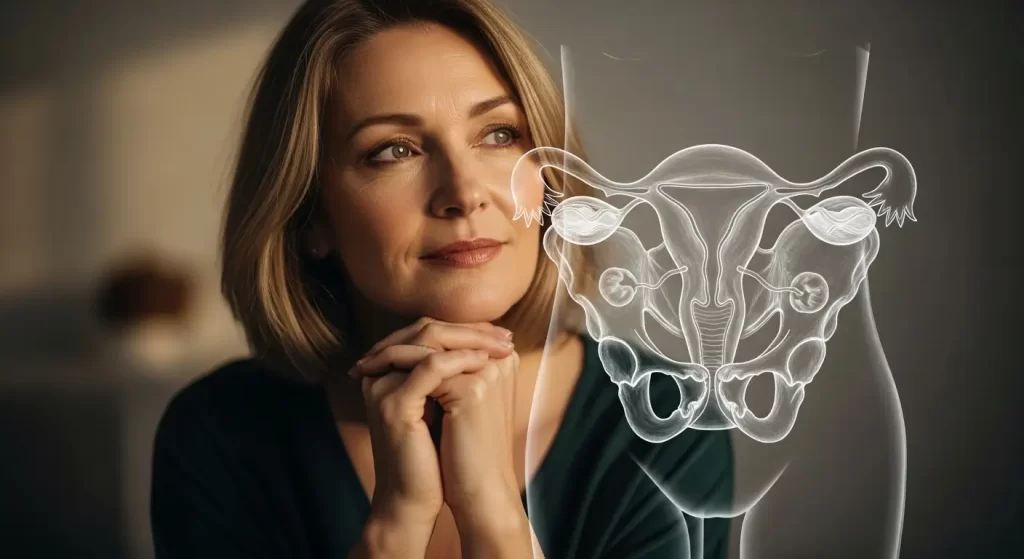
As we move through midlife, the body undergoes profound changes — some visible, others deeply internal. One of the most impactful, especially when it comes to intimacy, is the sharp decline in estrogen during perimenopause and menopause.
Estrogen plays a critical role in keeping the vaginal tissues plump, moist, elastic, and well-lubricated. When this hormone drops, several changes take place:
- The skin of the vulva and vaginal entrance becomes thinner, more fragile, and more sensitive.
- Natural lubrication decreases — what was once soft and moist may now feel dry, tight, or even brittle.
- The vaginal pH becomes more alkaline, and blood flow to the area diminishes.
These shifts are part of what’s known as the Genitourinary Syndrome of Menopause (GSM) — and they affect nearly half of all postmenopausal women.
But that’s not the whole story.
In many cases, the pain comes not just from the surface, but from the deep muscles of the pelvic floor. These muscles — which support your uterus, bladder, and bowels — can become tense or unresponsive after years of disuse, hormonal change, or emotional distress.
When tight or inflamed, they can restrict blood flow, reduce sensation, and make any touch — even gentle — feel uncomfortable.
It’s like trying to open a flower that’s closed itself for protection.
It’s not that it can’t bloom — it just needs the right environment to feel safe again.
Understanding these causes changes everything.
Because pain during intimacy after 50, when understood, becomes not a flaw — but a signal. A request for care.

When Fear Arrives Before the Touch

“I don’t even try anymore. My body tenses up before anything even begins.”
This isn’t uncommon.
In fact, for many women, the pain during intimacy after 50, doesn’t start with the touch — it starts long before.
With a memory.
A hesitation.
A silent clenching the body does all on its own.
Our bodies remember.
And when a once-pleasurable experience becomes repeatedly painful, the brain builds shortcuts to protect us. It anticipates pain.
It sends warning signals.
And the body responds by shutting down.
The result?
Muscle tension — especially in the pelvic floor — becomes a silent habit.
A reflex of defense.
It’s the body saying,
“Last time this hurt. Let’s not do that again.”
This cycle is incredibly common — and deeply misunderstood.
It often gets mislabeled as “low libido” or “disinterest,” but what it really is… is fear.
Fear of pain.
Fear of disappointment.
Fear of being touched in a way that doesn’t feel safe anymore.
And slowly, without ever saying it aloud, a woman begins to withdraw — not just from her partner, but from herself.
This kind of pain cannot be pushed through.
It needs to be softened. Listened to. Gently unwound.
That’s why the first step toward healing isn’t always physical. It’s emotional.
It’s giving yourself permission to pause. To breathe. To approach touch again — not as an obligation, but as an invitation.
In the next chapter, we’ll explore what that care can look like:
Therapies, movements, and tools that don’t demand performance — but offer your body a new sense of safety.
Therapies That Listen to the Body

When pain during intimacy after 50 shows up, many women choose to quietly pull away.
Not just from intimacy — but from their own bodies.
They assume there’s nothing to be done. Or worse, that they’re the problem. That they’ve become “too dry,” “too old,” or “too complicated to fix.”
But pain during intimacy after 50 doesn’t mean the end of pleasure.
It means your body is asking for a different kind of care.
And today, there are gentle, science-based therapies designed to meet that need — without rushing, forcing, or blaming.
Here are a few approaches I often recommend to my patients. Each one offers real relief, but only when guided by respect and patience.
Pelvic floor physical therapy
This is one of the most effective, yet least known, tools for restoring comfort and confidence.
A trained pelvic floor therapist can help release chronic muscle tension, increase circulation, and gently retrain the body to relax during touch.
Sessions may include internal massage, breathing techniques, biofeedback, or guided exercises. And often, just a few sessions can make a powerful difference.
It’s not about “tightening.”
It’s about remembering how to soften.
Intentional movement and breathwork
Before intimacy feels safe again, the nervous system has to feel calm.
Gentle hip stretches, pelvic tilts, and slow diaphragmatic breathing can help your body exit “defense mode” and move into a state of openness.
Something as simple as lying down, placing your hands over your lower belly, and breathing deeply for three minutes can shift everything.
Natural lubricants and vaginal moisturizers

Sometimes, hydration alone can relieve discomfort — but only if the product respects your body.
Look for lubricants without fragrances, artificial preservatives, or petroleum-based ingredients. Choose formulas with botanical oils, aloe, or hyaluronic acid — ingredients that nourish the skin and calm irritation.
Later in this article, I’ll share a product that has been a gentle turning point for many of my patients.
But remember: even the best product means little without a soft, conscious gesture behind it.
Layered care is the most powerful
The most lasting results often come from combining care:
movement, moisture, muscle work, and above all — emotional permission.
There is no one-size-fits-all solution.
But there is always a place to begin.
Even a small step — like trying a new routine, scheduling a consult, or choosing to breathe — is an act of reclamation.
Your body hasn’t stopped working.
It’s just asking for something different now.
Next, we’ll explore how that shift happens — when the body, once afraid, begins to awaken.
And how a certain natural gel has helped many women make that transition gently and with grace.
When the Body Stops Fearing the Touch

There comes a moment — quiet and subtle — when the body begins to soften.
It may not be a grand transformation. In fact, it often looks like the smallest things:
A breath that reaches deeper.
A hand that lingers a little longer.
A thought that says, “Maybe it won’t hurt this time.”
This is the moment I cherish most in my work.
Because it signals something deeper than physical healing — it’s the return of trust.
But for many women, even after they’ve hydrated, stretched, and breathed… the body still hesitates.
Not because it’s broken.
But because it needs something more.
A gentle nudge.
A reminder.
A sensation that says: “You’re safe now. You can respond.”
That’s when I often introduce a product that some of my patients have called a “turning point”: Vigorelle

What is Vigorelle?
Vigorelle is not just a lubricant.
It’s a natural arousal gel designed specifically for mature women — especially those whose bodies have become quiet, cautious, or disconnected from sensation.
Unlike many products, it contains no hormones and no harsh ingredients.
Instead, it uses:
- Damiana leaf – a plant traditionally used to awaken feminine desire
- Apricot kernel oil – cold-pressed, deeply nourishing to fragile skin
- Peppermint leaf oil – a subtle stimulant that enhances blood flow and creates a cool-to-warm awakening on the skin
Why it works — and when
The effect is not overwhelming.
There’s no “shock” to the system.
Instead, many women describe it as a gentle sequence:
A fresh coolness, like a breeze.
Followed by a soft, tingling warmth.
And finally — a sense of reawakening, as if the skin remembers.
One woman told me:
“It felt like a quiet flame was being lit. Not rushed. Just… welcomed.”
You can use it alone — as a ritual of reconnection.
Or with a partner — as a way to explore closeness again without fear.
But more than the product, it’s the gesture that matters.
When you apply it slowly, with breath, without expectation — you’re telling your body:
“You still matter. You still deserve sensation. And you still know how to feel.”
Remember: this isn’t about performance.
It’s about giving your body a reason to trust the touch again.

Restoring the Intimate Environment

“Dr. Ray… something just feels different down there. Not just dryness — everything. The smell, the sensitivity, even the way my clothes feel.”
It’s not always easy to explain.
Because it’s not always painful — but it’s deeply uncomfortable.
A shift you feel even in silence.
And that shift, while rarely discussed, has a name.
After menopause, your body’s intimate ecosystem begins to change.
This internal world — made up of bacteria, pH levels, moisture, and blood flow — is sensitive to hormones.
And when estrogen declines, everything within that environment begins to tilt out of balance.
The vaginal pH rises.
Natural acidity fades.
Protective bacteria (especially lactobacilli) decrease.
And opportunistic organisms can take over.
The result?
- Itching or burning
- Increased infections
- Unfamiliar odor
- Heightened sensitivity or fragility
- Even micro-tears after intimacy or hygiene routines
It’s not in your imagination.
It’s the loss of a system that used to protect and soothe you — now asking for your help to recover.
So how do we restore that invisible balance?
Feminine-targeted probiotics
Not just any probiotic — the right strains, for the right environment.
Strains like Lactobacillus reuteri and Lactobacillus rhamnosus help repopulate the vaginal flora, reacidify the pH, and bring back that natural freshness and resilience.
One product many women find helpful is A supplement like PH Defend Women’s Probiotic — a formula created specifically for vaginal comfort, without altering hormones.
Clinical studies show:
Regular use for 8–12 weeks can reduce recurrence of infections, restore natural lubrication, and even enhance response to touch.
It’s slow. But powerful.
Feed the flora from within
The gut and vaginal ecosystems are closely linked.
Eating foods rich in fiber and prebiotics — fruits, seeds, fermented vegetables — helps support the healthy bacteria your body wants to grow.
Even a cup of warm tea made with flaxseed or a bowl of berries in the afternoon can nourish your internal terrain.
Understand that comfort begins in the invisible
This part of the body doesn’t always get attention.
It’s not glamorous. It’s not obvious. But it holds incredible power.
When your intimate environment feels fresh, safe, and balanced — the rest of you begins to soften.
Your nervous system relaxes.
Your skin becomes more responsive.
And your desire, slowly, stops hiding.
Sometimes the most meaningful change isn’t visible in the mirror.
It’s felt in how you walk, how you sleep, and how you begin to trust again.
Reconnecting with Your Own Body

Sometimes, healing begins not with a treatment — but with a touch.
Not someone else’s.
Yours.
A slow hand. A deep breath.
A moment when you pause and say, “I’m still here.”
After 50, many women feel they’ve drifted from their own bodies.
The mirror feels unfamiliar.
Intimacy feels distant.
And pleasure… like a memory that belongs to someone else.
But here’s what I know, from listening to hundreds of women:
The body remembers.
It may be quieter now.
More cautious.
But it still wants to feel.
It’s just waiting for a different approach.
One that isn’t about performing or “fixing.”
One that begins with permission.
Permission to explore gently.
To touch without rushing.
To breathe without needing a reason.
It can be as simple as:
- Choosing a soft fabric against your skin
- Rubbing oil or Vigorelle into your thighs, not for a goal, but as a ritual
- Stretching your hips in silence with your eyes closed
- Placing a hand over your chest and simply resting there
One woman, 68, told me after trying Vigorelle:
“I cried in the shower. Because for the first time in years, I touched myself with care — not with urgency, not with frustration. Just care.”
That’s what this journey is about.
Not reigniting an old fire.
But discovering a gentler warmth — one that fits who you are today.
And that warmth lives in the pause.
In the breath.
In the choice to meet yourself again, not as you were… but as you are now.
Pain Isn’t the End of the Story

Pain during intimacy isn’t just physical.
It touches the way you see yourself.
The way you open up.
The way you allow yourself to be seen — or not.
Many women carry this pain silently, believing they’ve simply “aged out” of desire.
That this chapter is over.
That they’ve crossed some invisible line and the body no longer responds.
But let me tell you, gently and clearly:
It wasn’t your body that gave up.
It was the care it needed… that got postponed.
And the beautiful truth?
That care can return. One breath at a time. One moment of softness. One gesture of permission.
Whether it’s a probiotic to restore balance.
A stretch to awaken your hips.
Or a natural gel like Vigorelle to remind your skin how to feel…

The point isn’t the product.
It’s the message: “You still matter. You still feel. And you still deserve to enjoy your body — even now, especially now.”
Conclusion – A Quiet Invitation to Come Back Home
In this article, we explored:
- What really causes pain during intimacy after 50
- How hormonal, muscular, and emotional changes are all connected
- Gentle, evidence-based therapies that listen rather than force
- And the possibility of reconnection — with your body, with touch, with yourself
Now, I want to ask you a question — not as a doctor, but as another woman:
Are you still listening when your body asks for care?
Or have you been silencing it, out of fear, shame, or simply habit?
If this article touched something in you, perhaps you’re ready to try again — slowly, differently, in your own way.
And if you’d like a companion for that journey, I also recommend reading:
“Vaginal Dryness After Menopause: 5 Natural Solutions That Really Work.
And remember:
A well-cared-for woman isn’t vain. She’s remembered — inside and out.
Pain during intimacy after 50 doesn’t mean the end of intimacy — it means a new beginning.
