
Introduction
“Dr. Eleanor… it feels like my body has forgotten how to feel.”
That sentence no longer surprises me. I hear it — in different words, different voices — almost every week.
Self‑esteem and intimacy after 50 have become topics people rarely talk about.
Or worse — they’re treated as if they no longer matter.
But in truth, they are essential.
To emotional well-being.
To physical health.
And even… to a woman’s longevity.
After 50, so many women live this feeling in silence.
Hormonal shifts, emotional changes, the way our bodies age — they don’t just alter how we look. They change how we feel.
And sometimes, that change touches something deeper:
Self‑esteem begins to fade.
Intimacy slips away.
But what so few women know — or dare to believe — is that it is absolutely possible to rebuild your confidence. To reconnect with pleasure.
Not by going back to who you were…
But by gently becoming who you are now ready to be.
The Invisible Connection Between Self‑Esteem and Intimacy After 50

Many women don’t know how to name what they’re feeling — and because of that, they assume the discomfort is just “normal.”
But it’s not.
And it directly affects their self‑esteem and intimate life after 50.
Self‑esteem is not just liking what you see in the mirror.
It’s how we feel inside our own skin.
It’s how much we believe we still have something to offer — and something to feel.
After fifty, that inner relationship begins to change.
The body changes. Energy shifts. Sometimes, the relationship changes too. And before we realize, many women begin to drift away not just from pleasure, but from themselves.
Desire hides.
Intimacy withdraws.
And the woman who once felt secure, vibrant, sensual… begins to doubt her own worth.
But here’s something important: self‑esteem and pleasure are deeply connected.
Studies show that women with preserved self‑esteem after menopause have significantly higher levels of sexual satisfaction.
Another study with older couples showed that emotional intimacy and positive self‑image were the biggest predictors of pleasure — much more than age, marital status, or how often intimacy happens.
In other words: the body may age. But pleasure doesn’t have to disappear with it.
Still, for that to happen, we must look inward.
And begin to rebuild that confidence with gentleness, courage — and truth.
Physical and Hormonal Changes That Can Shake Confidence
It’s not just about appearance.
Often, what shakes self‑esteem after fifty are silent changes — things happening inside, but reflected everywhere: mood, energy, libido, the way we move, breathe… even how we relate emotionally.
Menopause is a biological milestone.
But for many women, it also represents a symbolic break with the image they had of themselves.
The drop in estrogen levels directly affects intimate health:
- The vaginal lining loses elasticity and moisture.
- The pH balance shifts, which can lead to irritation and recurring infections.
- Blood flow to the intimate area decreases, reducing sensitivity to touch.
And it doesn’t stop there.
Some women also experience a drop in testosterone, a hormone tied not only to desire, but also to vitality, strength, even mental clarity.
Sleep may become fragmented.
The body retains more belly fat.
Skin loses collagen, muscles become more lax.
And suddenly, even getting dressed becomes an emotional challenge.
It’s as though the mirror stops recognizing who you were — without yet showing who you are becoming.
And that shakes you.
Not because beauty is gone — but because we’ve been taught to link worth to vigor, youth, appearance.
Rarely do we speak of the beauty born of presence. Of wisdom. Of a body that no longer needs to prove anything — but can still give itself fully.
That’s why understanding what is happening to the body is an act of love.
Naming the symptoms, seeking help, adjusting care — all are parts of a larger process: rebuilding your confidence from what is real.
And real, my dear, can be beautiful too.
Emotional, Psychological, and Social Blocks
Not all pain is felt in the body.
Some live in silence. Others, in memory.
And many dwell in what we were never taught to name.
A woman in her fifties often carries tremendous emotional baggage — stories unspoken, loves delayed, fears stashed away, roles that always demanded giving more than being heard.
And with all that, desire… retreats.
Even when the body is healthy, the mind can create invisible barriers:
- Shame over how the body has changed.
- Fear of pain or of not “working as before.”
- Feeling no longer attractive or “interesting.”
- Doubt about what still arouses pleasure.
- Lack of open conversation with a partner — or fear of being judged by them.
Caring for your image, your touch, and your connection with your own body
is essential to rebuilding self‑esteem and intimacy after 50 —
with dignity… and with pleasure.
Moreover, female aging is still seen, in many contexts, as a symbolic end to sensuality.
Worse: as if sexuality is a privilege of youth.
That social narrative marks us deeply.
Many women begin to live intimacy as a concession — or abandon it entirely because they believe “that chapter is closed.”
But science says otherwise.
A 2025 study published in BMC Public Health showed that women who received proper sexual and emotional education after menopause reported significant improvements in self‑confidence, desire, and pleasure.
In other words: it’s not too late. And it’s not only physical.
Pleasure does need skin, yes.
But first and foremost, it needs internal permission.
Courage to question ideas you were taught.
And space for you to rebuild — at your pace, in your own way — what has been silenced for so long.
Concrete Practices to Reconnect with Pleasure
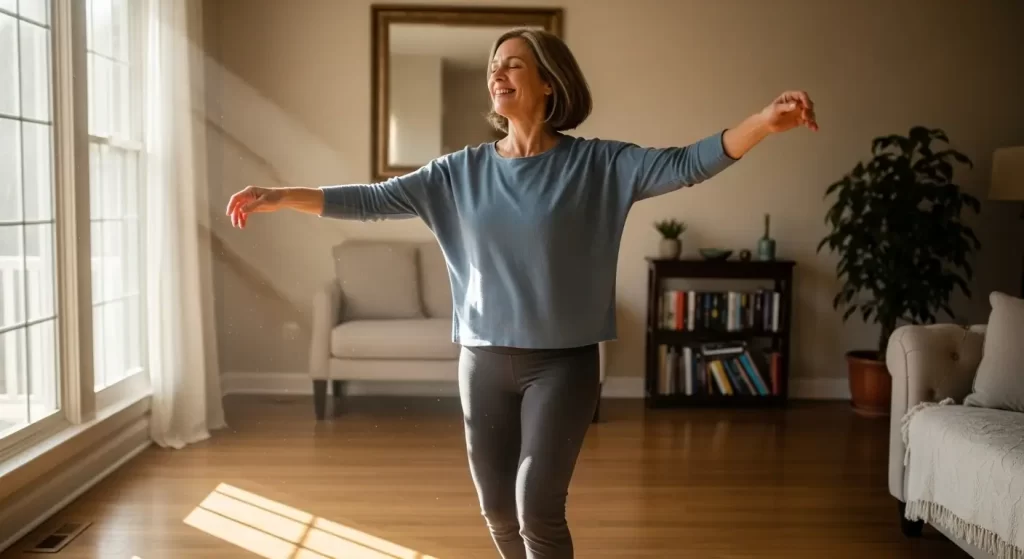
You don’t have to wait for desire to appear to start caring for it. Many times, the action comes before the longing. And it is in practice — in the body, in touch — that pleasure draws closer.
After fifty, pleasure changes.
It is no longer so impulsive, so automatic.
But it can become deeper, more present, more yours.
The question is: how to reconnect, without rush or guilt?
Here are some practices I recommend to my patients — not as formulas, but as invitations:
1 – Mindful touch — alone, with time
Lie down, breathe deeply, and explore your body with curiosity. No goal, no expectation. Just touch.
Use pure plant oils or a sensory gel I often suggest — think apricot oil, damiana, gentle mint — ingredients that encourage circulation and can help “wake up” areas that have grown quiet.
More than lubrication, this touch nourishes. It tells the body: “You are still able to feel.”
2 – Movement that activates your feminine center
Walk 20 minutes a day.
Dance alone in your home.
Do poses that open the hips, like butterfly stretch or cat‑cow.
These movements boost pelvic blood flow, activate deep muscles, and help the body leave “defense” mode and enter “presence” mode.
3 – Intimate dialogue with your partner
If there is a partner, conversation is essential.
Without pressure, without comparisons to the past.
Talk about what feels good, what hurts, what needs to shift.
Make agreements: “Let’s explore without hurry.”, “Let’s focus on touch, not performance.”
4 – Sensory exploration with small aids
Intimate toys (like low‑intensity vibrators) can be allies — not to replace human touch, but to deepen self‑knowledge.
Studies show their use may help vaginal health, improve circulation, even reduce discomfort related to dryness.
5 – Pleasure rituals without the need for intercourse
Baths by candlelight.
Erotic reading.
Scalp massage.
Lingering kisses.
Pleasure doesn’t always need a “destination”. Sometimes, it just needs permission to begin.
Professional Support and Body-Respecting Interventions

Caring for your intimate life isn’t vanity.
It’s health. It’s well-being.
It’s a vital part of your quality of life — even if no one ever taught you that.
Many women come to my office after years of silence.
They feel pain, or an absence of pleasure, or shame.
And they believe all that’s left is to “accept it.”
But accepting your body doesn’t mean giving up on it.
There are medical and therapeutic tools that help — tremendously.
As long as they honor your pace, your truth, your body.
When is it time to seek help?
- When there’s pain during touch, burning, or persistent discomfort.
- When natural lubrication disappears and intimacy becomes difficult.
- When libido fades, accompanied by sadness, confusion, or low self-worth.
- When relationship shifts create distance, and conversation feels impossible.
In these cases, look for a gynecologist who truly listens, a pelvic floor therapist, a sex therapist — or a team that welcomes mature women as they are: whole.
Safe and Effective Treatments After 50
- Low-dose local estrogen therapies that restore tissue without the systemic risks of hormone replacement.
- Regenerative creams with hyaluronic acid that hydrate and strengthen intimate skin.
- Vaginal probiotics to help restore a healthy microbiome.
- Vaginal laser therapy, in specific cases, to stimulate collagen and improve blood flow.
- Sexual or cognitive therapy to gently work through internal blocks and fears.
A Care That Blends Science with Sensitivity
Intervention doesn’t have to mean artificial.
There are natural, safe, clinically proven options — that respect the mature body, without forcing it to behave like a 20-year-old’s.
The most important thing is this: the decision is yours.
Your body, your story, your rhythm.
The role of medicine — and of real care — is simply this: to open doors.
With ethics. With listening. With tenderness.
Real Stories of Women Who Reclaimed Pleasure
It’s not always a revolution.
Sometimes, it’s just a gesture.
A small moment of reconnection that changes everything.
I think of two women I’ve worked with.
Very different — but they had one thing in common: the courage to begin again.
Margaret, 63
Margaret came to me and said,
“Dr. Eleanor, it’s been five years since I’ve wanted anything. Not even myself.”
She had gone through a painful separation and hadn’t touched herself since.
She was ashamed of the softness, the belly, the delicate skin.
She said her body “didn’t match desire anymore.”
We started with mindful touch.
She began using pure apricot oil, fragrant like a gentle hug.
Then she agreed to try a natural sensory cream with botanical extracts that gently stimulate circulation and reawaken sensitivity.
“For the first time, I felt a warmth rise from deep inside. It wasn’t fire… it was presence.”
She started looking at herself in the mirror again.
She bought a new nightgown — not for anyone else, but for herself.
Two months later, she came back smiling:
“I can feel again. And that’s mine.”
Linda, 58
Married for over 30 years, Linda had never talked about pleasure.
Not with her husband. Not even with herself.
She had always seen sex as a duty.
After menopause, the discomfort grew — and she pulled away completely.
Until one day, during a session, she said:
“I don’t want to live the rest of my life never knowing what real pleasure feels like.”
We helped her learn about her own body.
She used soft vibrators, read erotic stories with curiosity, and created a nightly ritual with a plant-based gel designed to awaken the skin gently.
She invited her husband to talk.
“He listened like he never had before.
And he touched me like I was new — not young, new. Like a beginning.”
Today, she says she’s discovered a kind of pleasure she never thought possible — because, finally, it was hers.
Stories like these remind me:
There’s no “right time” to begin feeling again.
There’s only the moment a woman decides.
And that, my dear, changes everything.
Common Barriers — and How to Gently Overcome Them

Even with the desire to reconnect, many women run into something that feels bigger than themselves.
Fear. Shame. Lack of time. Lack of habit. Lack of conversation.
Most of the time, these barriers are invisible — but deeply real.
And the hardest part?
They rarely come alone.
They stack up. And they feed on silence.
Let’s talk about the most common ones — and how to face each, with honesty and care:

“I don’t feel attractive anymore”
This is one of the most frequent things I hear.
And what’s underneath it isn’t vanity — it’s grief.
It’s hard to feel desire when you no longer recognize yourself in the mirror.
When the marks of time seem to have “taken something from you.”
But here’s the truth: desire doesn’t come from appearance — it comes from presence.
Start with small gestures:
A fragrant oil.
Bedsheets that glide softly.
A piece of clothing just for you.
Not to look young — but to feel that you still exist in your own body.
“I’m afraid it’s going to hurt”
The fear of pain can be more paralyzing than pain itself.
And often, it comes from unresolved past experiences.
The good news?
Pain is not inevitable.
With the right preparation, attention, and gentle products, it’s entirely possible to rediscover touch with pleasure — not tension.
If there’s discomfort, see a gynecologist who truly listens.
There are regenerative creams, pelvic physical therapy, and even simple exercises that can restore comfort and elasticity to your intimate area.
“My partner doesn’t understand”
Disconnection in a relationship is common.
Especially when your partner is also going through their own aging process — often in silence.
What helps?
- Open conversations, without blame.
- Inviting your partner to explore the mature body together — slowly, without performance.
- Sharing articles, videos, or even inviting them to attend a session or read something with you.
When vulnerability is shared, the bond grows stronger.
“I feel ridiculous even trying”
This is a hard one to name.
Many women feel it’s “too late,” or that “this just isn’t for me anymore.”
But pleasure has no expiration date.
Touch has no deadline.
What you call ridiculous… might just be the beginning of a beautiful reconnection.
And if fear is present, start in secret.
In your own time.
With the lights dim.
Eyes closed.
Like finding yourself again in the dark — before showing up in the light.
A New Beginning: When Pleasure Finds Its Place in Your Life Again

Years ago, a patient — Martha, 66 — looked at me with eyes full of tears and said:
“Doctor… it feels like there’s no room for pleasure in my life anymore.”
She wasn’t just talking about her body.
She was talking about life.
The demands. The exhaustion. The lack of space just for herself.
And most of all, the absence of permission — to feel, to want, to try something new, even after everything.
But what she discovered — and what so many other women have since discovered — is this:
Pleasure never stopped fitting.
What was missing… was the gesture of returning to herself.
Maybe you’re there too, on the other side of this story.
Part of you feeling numb. Another part no longer believing.
Maybe you’ve convinced yourself that pleasure is part of the past.
But I need to tell you:
Pleasure was never about youth.
It’s always been about presence.
It doesn’t matter if your skin has changed.
If lubrication isn’t the same.
If desire no longer arrives on its own.
All of that is real — but none of it is the end.
It’s simply the beginning… of a different kind of pleasure.
A deeper, more sensual, more mature kind.
A pleasure that’s born from touch without pressure…
From connection without hurry…
From a body that no longer needs to prove anything — just feel.
And that kind of pleasure only shows up when a woman dares to say again:
“I still belong to myself.”

Conclusion
Self‑esteem and intimacy after 50 are not secondary.
They’re vital.
And they can be restored —
with small, intentional acts of listening, of touch, and of truth.
Your intimate life after 50 doesn’t end.
It simply changes form.
Maybe you need to rediscover your rhythm.
Maybe you need to relearn the language of touch.
Or maybe… you just need to remember that you’re still allowed to be touched — with truth, with tenderness, with longing.
Wherever you’re starting from, know this:
It’s not too late.
It’s not foolish.
And you’re not alone.
Many women go through this phase believing their body has failed them.
But in truth… what’s been missing is care, space, and real information.
And that’s why I wrote this message.
To remind you that pleasure is a right.
That self‑esteem doesn’t come from appearance — it comes from intention.
And that reconnecting with your body can be — truly — an act of courage… and joy.
If you’d like to begin with something simple, here’s my suggestion:
Set aside just 10 minutes of your day.
Use a warming, nourishing sensory oil or gel — one with botanical extracts that awaken and support your skin.
Lie down in dim light.
And touch yourself… not as a remedy,
but as a way of saying sorry to your body — for all the times you forgot to feel.
Let it be a homecoming.
And here’s a question to reflect on:
Do you still allow yourself to be touched — or have you silenced that part of you?
If this message touched you, I also recommend:
“Pain During Intimacy After 50: What Your Body Might Be Trying to Tell You” — a complete, respectful guide to the mature female body.
And remember, my dear:
A well-cared-for woman is not vain.
She’s remembered — inside and out.
Not for how she looks…
But for how she feels.
And for the way she keeps choosing herself — every single day.
That’s why I’m here.
To help you remember who you are —
even when everything else feels like it’s changed.